
IA Agêntica
Multi-agent systems: coordinate agents and avoid failures
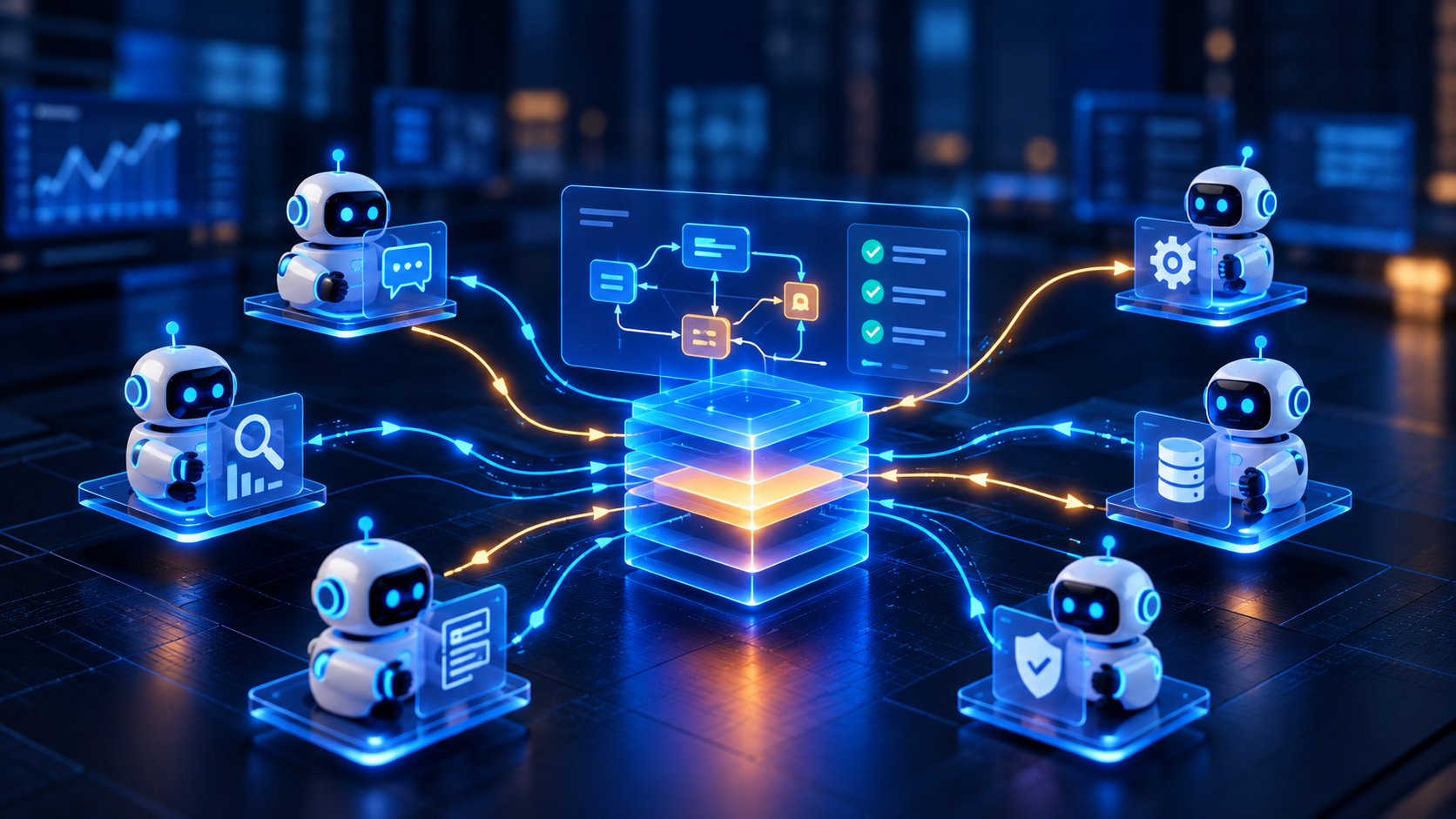
Imagine a company that uses different artificial intelligence agents to handle customer requests. One agent identifies the problem, another looks up financial information, and a third checks the status of a given service before executing an action.
Each agent may work correctly when evaluated individually. But what happens when incorrect information is passed between them? Or when two agents make incompatible decisions about the same request?
This is one of the challenges of multi-agent systems, structures in which different AI agents collaborate to perform tasks that require multiple capabilities, knowledge, or processing steps.
According to a Deloitte survey published in August 2026, only 15% of the organizations surveyed had achieved orchestrated adoption of multiple agents at scale. The same study shows that only 5% considered their business processes highly prepared to work with AI agents [1].
The indicators help size an important difficulty. Putting agents into operation is one thing. Coordinating them reliably, especially when they take part in processes that cross different systems and departments, is another.
Why coordinating agents is different from putting several agents into operation
The main advantage of multi-agent systems is allowing different agents to specialize in certain functions.
One agent can interpret requests, another can analyze information, and a third can execute activities in corporate systems. When they work in a coordinated way, they can take part in processes more complex than those carried out individually.
However, this collaboration does not happen automatically.
It is necessary to define how tasks will be distributed, which information will be shared, when one agent may hand an activity over to another, and which conditions must be met before a given action is executed.
Microsoft describes different AI agent orchestration patterns, including sequential execution, parallel processing, and dynamic handoff of tasks between specialized agents [2].
These approaches serve distinct needs. In a sequential process, completing one step depends on the result of the previous one. In parallel activities, different agents can work simultaneously and their results need to be brought together later.
There is also the mechanism known as handoff, in which one agent transfers control of a given task to another agent better suited to the situation.
The central point is that having several agents available does not mean having an effectively coordinated multi-agent system.
The organization needs to understand how these agents interact, which decisions they can make, and how their activities contribute to the final result of the process.
In addition, not every activity requires multiple agents. Microsoft itself recommends assessing whether the added coordination complexity is justified, considering costs, latency, and possible failures [2].
How cascading failures arise in multi-agent systems
When several agents take part in a process, an error may stop being an isolated problem.
Consider the customer service example again. One agent misinterprets a customer’s request and forwards incomplete information to another agent. That agent, in turn, uses this data to make a decision that will be executed by a third.
Even if the following agents work according to their instructions, the final result may be compromised.
The problem is not necessarily in a single agent, but in how information and decisions flow between them.
An academic study presented at NeurIPS 2025, one of the main international conferences on artificial intelligence and machine learning research, titled Why Do Multi-Agent LLM Systems Fail?, analyzed challenges of multi-agent systems based on language models and identified 14 distinct failure modes, organized into three categories: system specification and design problems, misalignment between agents, and task verification or termination failures [3].
Among the situations identified are difficulties in correctly fulfilling the defined roles, loss of information during collaboration, repetition of steps, and inadequate termination of activities.
These results were obtained in experimental environments and do not represent a general failure rate in business operations. Even so, they offer evidence that the reliability of a multi-agent system depends on factors beyond the individual quality of the models used.
An agent can correctly perform its own task and still contribute to an incorrect result when it receives inadequate information or takes part in a poorly coordinated sequence.
Another risk appears when different agents have permissions to act on the same systems or resources. Without adequate limits, decisions made at different steps can generate conflicts or execute actions that should depend on validation.
That is why coordination needs to consider not only the sequence of activities, but also the conditions under which each agent can act, interrupt an execution, or request human intervention.
Agent observability also gains importance in this scenario. When a task involves several agents, analyzing only the final result may be insufficient to understand where a problem occurred.
It is necessary to follow the execution trajectory and identify which information, decisions, and interactions contributed to a given result.
The challenge grows when agents from different platforms need to work together
The complexity of multi-agent systems tends to grow when agents are developed by different teams or use platforms and tools from different vendors.
In this scenario, each agent may have its own mechanisms for communication, authentication, execution, and monitoring.
Interoperability becomes an important need.
An example of this evolution is the Agent2Agent (A2A) protocol, created to facilitate communication and collaboration between AI agents. In April 2026, the Linux Foundation reported that the standard already had the support of more than 150 organizations, including relevant companies in the technology ecosystem [4].
The advance of these standards favors integration between different platforms. However, allowing agents to communicate does not automatically solve the challenges of coordination and governance.
A company still needs to know which agents take part in a given process, how tasks are handed over, which permissions are involved, and how decisions can be tracked.
This control becomes especially important when agents stop only recommending actions and start executing them in corporate systems.
The greater the autonomy and interdependence between agents, the greater the need to follow the complete process, and not only the individual functioning of each component.
This does not mean creating human oversight for every activity, as we covered in human-in-the-loop and autonomy. The goal is to establish criteria proportional to risk, with clear limits of action, tracking mechanisms, and the possibility of intervention when necessary.
The expansion of multi-agent systems will depend not only on agents’ ability to perform tasks, but on how reliably they can work together.
From vision to practice: ARGUS
Coordinating multiple agents requires an operational view that makes it possible to follow their interactions, decisions, and activities across different systems.
It is in this context that ARGUS, the Operational and Agentic Intelligence platform from Target Solutions, contributes to corporate operations.
Through its AgentOps capabilities, ARGUS supports the orchestration, monitoring, observability, and governance of AI agents, offering visibility into their activity and contributing to tracking the processes in which they take part.
The proposal is to connect agents, people, and tools in a shared operational context, allowing different components of the operation to act in a more coordinated way, with traceability and control.
This approach gains relevance when agents are developed on distinct platforms or need to interact with existing corporate systems.
Instead of replacing those tools, ARGUS acts as a layer of intelligence and governance that helps organizations expand their use of agents without losing sight of their operation.
Get to know ARGUS and see how it works in practice.
About the author
Paulo Florêncio de Menezes is an entrepreneur, partner, and co-founder of companies such as Target Solutions, BiPTT, and ARGUS.
He holds a degree in Data Processing from the Federal University of Amazonas (UFAM), an MBA in Business Management from Fundação Dom Cabral (FDC), and a Professional Master’s in Economics from Fundação Getulio Vargas (FGV).
In his Master’s research, he developed the IBEOP-IA (Brazilian Index of Potential Occupational Exposure to Artificial Intelligence), investigating the potential exposure of Brazilian occupations to AI capabilities by combining occupational data, artificial intelligence patents, and natural language processing techniques.
References
[1] Deloitte. AI Agents Are Only the Beginning: Deloitte Survey Examines AI Readiness for Agentic AI Success. Aug. 12, 2026.
[2] Microsoft. AI Agent Orchestration Patterns. Azure Architecture Center.
[3] Cemri, M. et al. Why Do Multi-Agent LLM Systems Fail? NeurIPS 2025.
[4] Linux Foundation. A2A Protocol Surpasses 150 Organizations, Lands in Major Cloud Platforms, and Sees Enterprise Production Use in First Year. Apr. 9, 2026.