

Anticipate failures, reduce incidents and take control of your operations with AIOps
AIOps platform with artificial intelligence to consolidate and correlate events from multiple sources, prevent failures and increase control and availability in critical IT and Telecom infrastructures.
Schedule a demo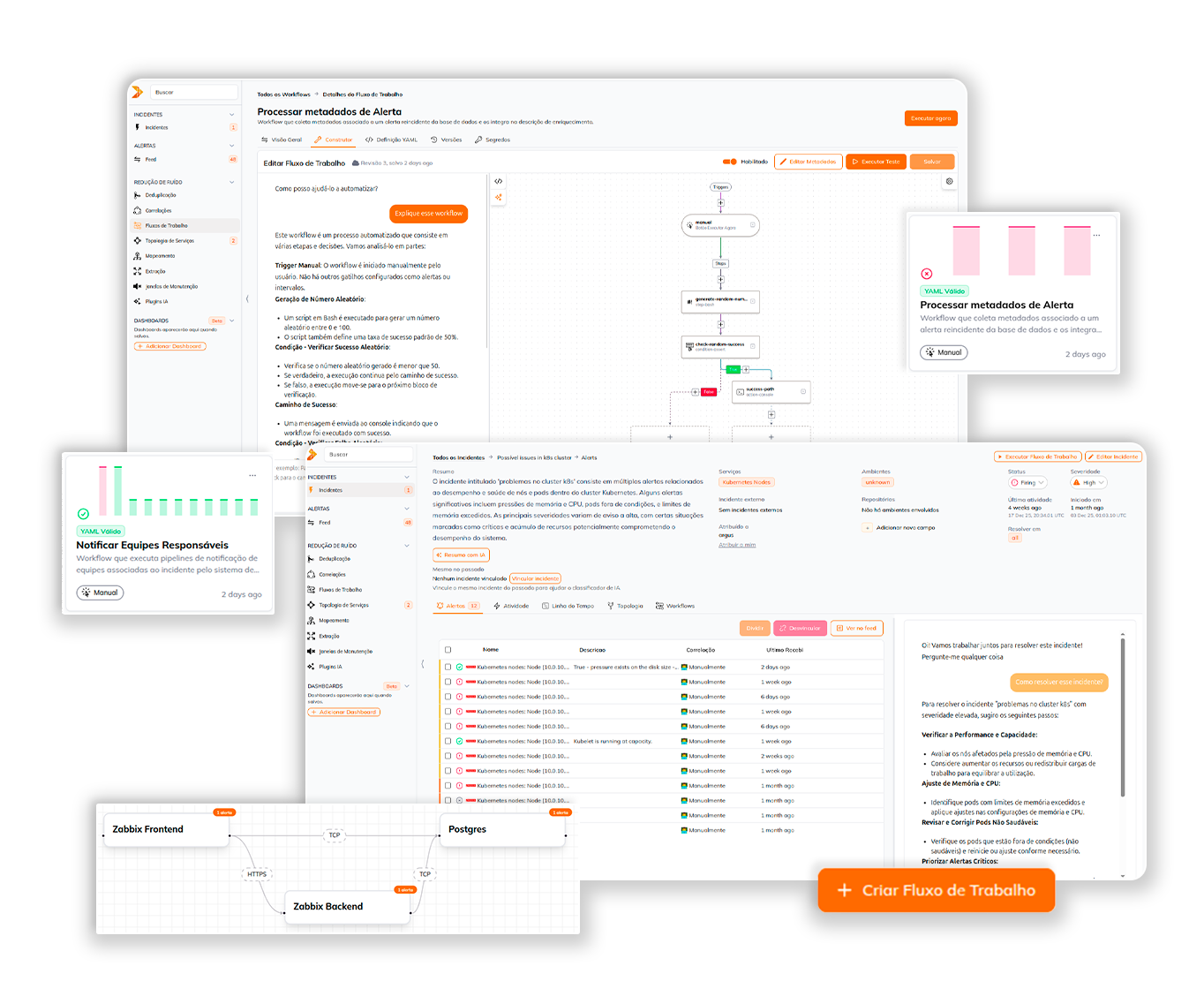
From 200,000 raw alerts to just 50 truly relevant work orders.
Mobilization time cut from 30 minutes to just 30 seconds.
Fewer unnecessary truck rolls thanks to proactive detection and remote remediation.

Argus is an enterprise AIOps platform designed to turn operational data into intelligent decisions, automation and predictability.
It adds intelligence on top of your monitoring tools, correlating events, detecting anomalies and predicting failures before they impact your services — whether in enterprise IT, data centers, industry, financial services or telecom.
- An integrated view of your entire environment
- Fewer false positives and less operational noise
- Proactive detection and failure prediction
- Prioritization by service and SLA impact
How Argus delivers operational value
Intelligent event correlation
Relates heterogeneous data in operational context.
Automated detection and prediction
Finds patterns and anomalies without manual intervention.
Impact-based prioritization
Identifies what really matters to meet SLAs.
Incident response automation
Speeds up resolution with automated actions and intelligent playbooks.
Common challenges in modern IT and Telecom operations
Fragmented environments
No unified visibility across systems, networks, applications and services.
Alert noise
Teams overloaded with irrelevant alarms that lack context.
Reactivity and uncertainty
Failures noticed only after they have already impacted the service.
SLAs and penalties
Financial and reputational risk from failing to detect critical incidents in time.
Native integrations with the leading IT operations platforms
-
 Zabbix
 -
 DataDog
 -
 Dynatrace
 -
 ServiceNow
 -
 Jira Software
 -
 GitHub
 -
 Kubernetes
 -
 Microsoft Teams
 -
 Splunk
 -
 Grafana
 -
 OpenShift
 -
 Telegram
 -
 App Dynamics
 -
 MongoDB
 -
 PostgreSQL
 -
 Slack
Slack -
 PagerDuty
 -
 Amazon CloudWatch
 -
 Azure Monitor
 -
 Elastic
Argus is a fit for you if:
- You lead IT operations or a NOC/SOC
- You need to reduce outages and anticipate incidents
- You work with hybrid or multicloud environments
- You depend on meeting critical SLAs
- You operate data centers, industrial production, financial services or corporate networks
Argus use cases:
- Automated anomaly detection in critical services
- Reduction of redundant alarms in the NOC
- Failure prediction before impact
- Intelligent prioritization by business impact
- Automated response to recurring incidents

Frequently Asked Questions
What exactly does Argus solve in my IT or Telecom environment?
Argus solves the problem of lack of visibility, correlation and predictability in IT and Telecom operations.
It turns large volumes of events, metrics and alerts into actionable insights, making it possible to detect, correlate and anticipate incidents before they impact critical services and SLAs.
Does Argus replace my current monitoring tools?
No. Argus does not replace your existing tools — it acts as an intelligent layer on top of them.
The platform integrates with the monitoring, logging, metrics and ITSM systems you already use, boosting the value of these tools with AIOps.
What kinds of environments can use Argus?
Argus is suited to any environment with critical infrastructure, including:
- Enterprise IT and data centers
- Hybrid and multicloud environments
- Industry, utilities and integrated OT
- Financial services, healthcare and government
- Carriers, ISPs and MSPs
The focus is not the industry, but operational complexity.
How does Argus use Artificial Intelligence (AIOps) in practice?
Argus uses AIOps and machine learning models to:
- Correlate events from multiple sources
- Identify behavior patterns and anomalies
- Detect subtle degradations and recurring failures
- Prioritize incidents by real impact
- Support automation and intelligent responses
All of this continuously and adaptively, learning from the behavior of the environment.
How soon does Argus start delivering value?
In general, the first gains appear within a few weeks, especially in:
- Alert noise reduction
- Better incident diagnosis
- Integrated visibility of the environment
As the models learn, Argus evolves toward failure prediction and automation, expanding ROI over time.
Does Argus help reduce failures and improve SLAs?
Yes. That is one of the platform's main goals.
Argus works proactively, anticipating failures and prioritizing the incidents with the highest SLA risk, which results in:
- Lower MTTR and MTTD
- Fewer critical outages
- Greater predictability and operational governance
Does Argus require a major deployment effort?
No. Argus was designed for fast integration, with no disruptive impact on operations.
Deployment is progressive, starting with data collection and correlation and evolving into advanced analytics and automation as the environment matures.
What return can I expect from adopting Argus?
The return shows up mainly as:
- Lower operating costs
- Less manual effort for teams
- Fewer recurring incidents
- Better availability and SLAs
- Faster, more accurate decision-making
Argus delivers measurable operational value, not just dashboards.