
IA Agêntica
Integrating artificial intelligence agents with corporate systems: security and governance
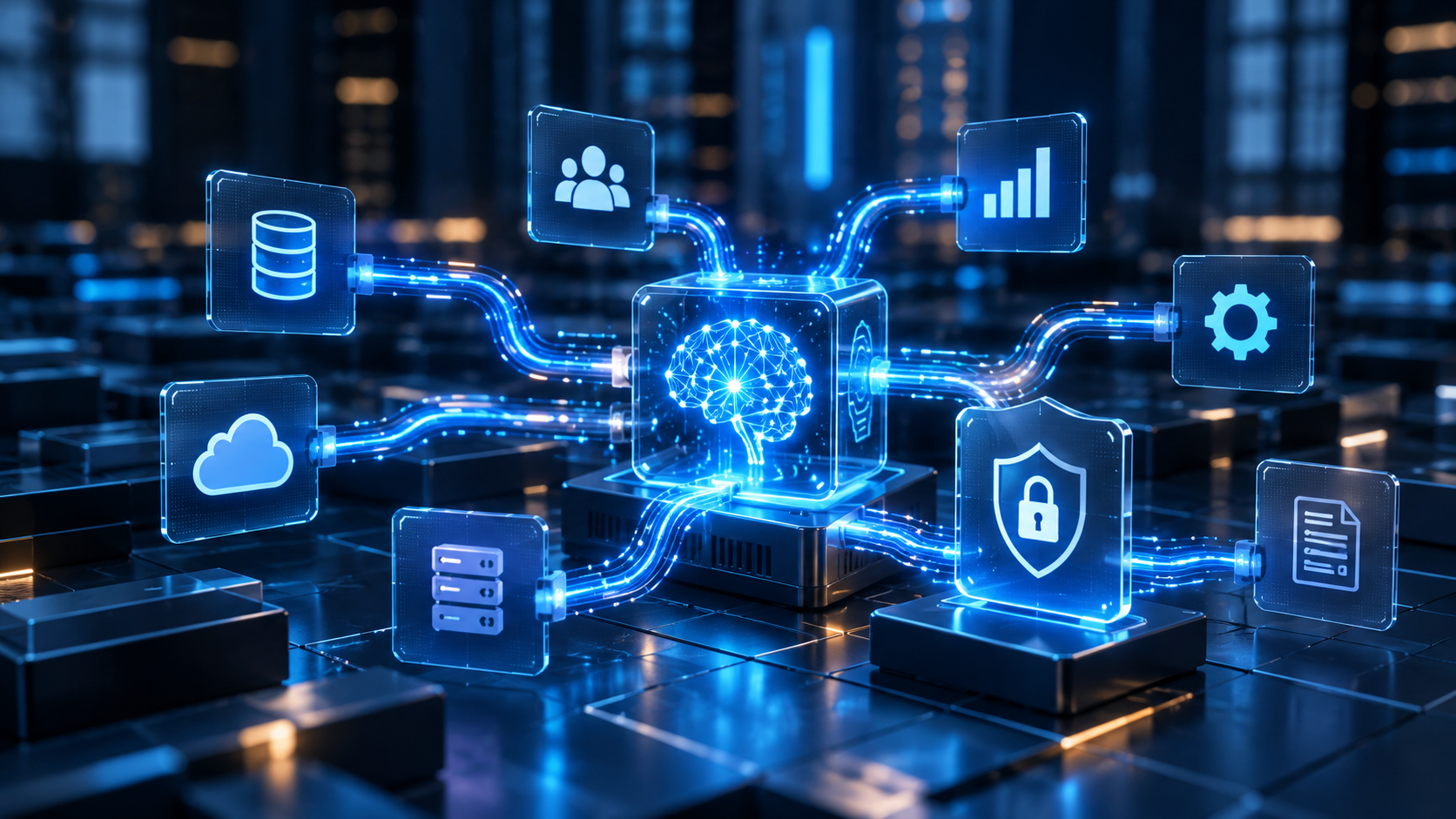
An artificial intelligence agent can analyze a request, look up information, and recommend an action in a few seconds. But for that capability to deliver concrete results in companies, it must work with systems already part of operations, such as ERP, CRM, support platforms, and service management tools.
That is when some of the biggest difficulties in Agentic AI appear. Integrating agents with corporate applications takes more than establishing technical connections. They must use reliable information, respect permissions, and execute actions within the limits the organization defines.
A Deloitte study published in August 2026 found that only 5% of surveyed organizations considered their processes highly prepared for AI agents. The survey also identified that 67% of respondents considered integration excessively expensive and complex [1].
The challenge, therefore, is not only in agents’ ability to execute tasks, but in preparing corporate environments so those tasks are carried out with security, governance, and reliability.
Integration starts with architecture, not connector choice
In February 2026, Gartner published the study How to Integrate AI Agents With Your Enterprise Applications, highlighting the need to balance technical architecture, integration practices, and governance so agents can use enterprise data and applications [2].
That guidance helps clarify an important decision. Before choosing how to connect an agent, the company needs to understand which systems participate in the process, which information will be used, and what type of action can be executed.
Consider a support operation where an agent receives a complaint, reviews the customer’s history, checks a work order, and recommends a course of action. The information may be spread across different applications, each with its own access and update rules.
Efficient integration must allow the agent to use that information without compromising data consistency or bypassing existing controls.
There are different technical paths for this. APIs enable communication with corporate applications, while connectors facilitate access to specific services and features. Model Context Protocol (MCP), an open protocol for interaction between agents and tools, offers a standardized way to expose resources to different AI applications.
Google Cloud’s architecture documentation explains that these alternatives play complementary roles. MCP favors interoperability, while API management platforms help control authentication, usage, and security of exposed services [3].
Standardizing communication does not, by itself, guarantee secure or governed integration. Technology choice must also consider system criticality, access requirements, and operating conditions.
That concern is reinforced by an IBM study on the Salesforce ecosystem, in which 69% of surveyed executives stated that interoperability between platforms is necessary for AI to deliver significant business impact [4].
Although that result does not represent all companies, it highlights the importance attributed to integration in enterprise environments that use multiple applications.
Security and governance must accompany every action
Once the connection is established, another question arises. What is the agent authorized to do inside the system?
Looking up information is different from changing it. Recommending a course of action is not the same as executing it. Likewise, access allowed for a support activity may not be adequate for financial operations or changes in critical systems.
For that reason, the agent’s identity, its permissions, and the limits of its autonomy must be defined before production.
Microsoft’s guidance for integrating agents with external services highlights the need for appropriate authentication and authorization mechanisms, including when connectors and MCP servers are used [5].
In practice, this means applying controls aligned with the agent’s purpose and preserving existing corporate policies. Some actions may run automatically, while others should require additional authorization or human oversight.
These mechanisms should not be treated only as restrictions. When limits are clear, the company can gradually expand agent autonomy, considering the importance and consequences of each activity.
Traceability is also essential. In processes involving customer data, transactions, or operational changes, it must be possible to identify which tools were used, which actions occurred, and under what conditions they were authorized.
The objective is to let the company benefit from automation without losing the ability to understand, oversee, and be accountable for executed decisions.
Reliable integration must also handle failures
Even when architecture and permissions are adequate, integration can present problems during operation.
A system may be temporarily unavailable, a query may return incomplete information, or a request may fail after a step has already executed. Depending on the process, a new attempt may produce duplicate actions or inconsistent results.
Returning to the support example, imagine an agent requests opening a work order but does not receive confirmation because communication was interrupted. If it automatically repeats the operation, it may end up creating two orders for the same problem.
That kind of situation shows why reliability depends not only on the connection but also on the ability to track what happens during execution.
Google Cloud recommends considering observability, ease of diagnosis, and robust error handling when selecting tools used by agents [3].
Successful integration is not only one that lets the agent execute an action, but one that keeps the process controllable when something does not go as expected.
This requires visibility into interactions, mechanisms to identify failures, and procedures to stop, correct, or escalate exceptional situations.
As different agents begin to act on the same systems and processes, that capability becomes even more important. The company needs to understand not only individual agent behavior but also the consequences of their actions on operations.
The main recommendation is to treat integration, security, and reliability as parts of the same architecture. That way, Agentic AI growth can leverage existing investments in corporate applications without multiplying isolated control mechanisms.
From vision to practice: ARGUS
Integrating AI agents with corporate systems broadens automation possibilities but also increases the need to track their actions across different tools and environments.
ARGUS, Target Solutions’ Operational and Agentic Intelligence platform, operates in this dimension through its AgentOps capabilities, supporting orchestration, monitoring, observability, and governance of agents.
By connecting agents, people, and tools in a shared operational context, the platform helps bring visibility to interactions and support more coordinated action. The AI Gateway layer complements this approach with access control, policies, and consumption mechanisms for AI resources.
The proposal is not to replace corporate systems nor to require AIOps adoption first. It is to help companies use agents in their existing environments with greater control, traceability, and oversight capability.
Learn about the ARGUS AgentOps proposal.
About Target Solutions
Target Solutions has spent more than 15 years helping organizations evolve their infrastructure, monitoring, observability, automation, and operational intelligence operations. Over that journey, it has participated in projects in complex environments across telecom, technology, government, energy, and large enterprises, contributing to higher operational efficiency and service reliability.
About the author
Paulo Florêncio de Menezes is cofounder of Target Solutions and has spent more than 15 years on projects related to infrastructure, monitoring, observability, automation, and IT and telecom operations. His path combines experience in technology, business management, commercial strategy, and developing solutions focused on efficiency and corporate operations transformation.
He holds a degree in Data Processing from the Federal University of Amazonas (UFAM), an MBA in Business Management from Fundação Dom Cabral (FDC), and completed the Professional Master’s in Economics at Fundação Getulio Vargas (FGV).
During his Master’s, he developed IBEOP-IA (Brazilian Index of Occupational Exposure Potential to Artificial Intelligence), research investigating Brazilian occupations’ potential exposure to AI capabilities by combining occupational data, artificial intelligence patents, and natural language processing techniques. The study contributes to understanding relationships among technological evolution, professional activities, and the labor market.
He currently focuses on developing solutions and strategies related to operational intelligence, AgentOps, AIOps, and artificial intelligence governance in enterprise environments.
References
[1] Deloitte. AI Agents Are Only the Beginning: Deloitte Survey Examines the AI Readiness Gap and Reveals How Enterprises Can Prepare for Agentic Success. Aug 12, 2026.
[2] Gartner. How to Integrate AI Agents With Your Enterprise Applications. Feb 23, 2026. Public research summary by Andrew Humphreys, Mark O’Neill, Shrey Pasricha, and Keith Guttridge.
[3] Google Cloud. Choose Your Agentic AI Architecture Components. Cloud Architecture Center.
[4] IBM Institute for Business Value. State of Salesforce 2025–2026.
[5] Microsoft. Configure Authentication for MCP and API Plugins in Agents. Microsoft Learn.